Average Reviews:

(More customer reviews)Back in 1987 I went to the store with my folks to purchase my birthday present. And I knew exactly what I wanted...a copy of "Axis & Allies". Having cut my teeth on "Risk" and "Stratego" I wanted something more grand. I was ready to graduate "Risk" and move on to something bigger and far better. When I got to the boardgame section I noticed that there were a lot of A&A games on the shelf, and nearby only a few copies of another game in the Gamemaster Series, "Fortress America". I thought long and hard for the space of 10 minutes as I moved back and forth between the two games...on the one hand I could get Fortress America and always come back and get A&A, I thought, and the FA box sure looked interesting and I wanted to play it. But in the end I opted to go with my original plan and get a copy of A&A. The five remaining copies of "Fortress America" were quickly snatched up and were gone by the time I came back two weeks later, and I didn't see another copy again for over 20 years. Ahh the mistakes of youth! One can get "Axis & Allies" almost anywhere now...but not so for this game, which can sell now on e-Bay for as much as $150, depending upon its condition. I finally got my much belated copy late last year.
The setting for "Fortress America" is that in the near future (for the 1980's that is) terrorists destroy the Middle-Eastern oil supply and the US innovates a new solar satellite energy system. The US also develops an advanced SDI (or "Star Wars" if you prefer) system which they integrate into the existing satellite network. With this defensive net placed over the continental US ballistic nuclear missile attacks become obsolete. The US becomes isolationist, while the rest of the world dissolves into political turmoil. As the US becomes more complacent their conventional forces go to pot while they feel safe under the SDI umbrella to protect them. Three separate foreign governments take it upon themselves to "correct" the issue by simultaneously invading and taking over the US, thus nullifying the world issue.
The game board displays a blow up version of the United States lower 48, as well as the 3 invasion zones (Pacific, Atlantic, and Mexico) and 30 US cities. The US is broken up into specific zones, or rather "theaters"; Eastern, Southern, Plains, Rocky Mountains, and Western, with several subzones depicting fuel, ore, or agricultural resources. The Invaders goal is to claim at least 18 US cities to win the game, the Invader with the most US cities and resource areas being declared the winner. While the Invaders are working together to beat American forces they are allowed to attack each other if any of the players feel it would be advantageous for them to do so (and oftentimes it is).
The US has it's work cut out for it. Assaulted on three sides the US has to consolidate it's forces to keep the Invaders at bay long enough for it's laser relay towers to get built up in strength (more on this later) and for the Invaders forces to simply run out of troops. And herein lies the real novelty behind "Fortress America". Both sides have a typical assortment of tanks, helicopters, infantry, and bombers. But the catch is that the invaders will receive regular reinforcements until Turn #6, at which point they have to take what they have and do the best they can. The US never runs out of reinforcements and can produce new ones via the use of "Partisan Cards". In addition to this the US player can place laser relay towers in a major city still under their control and before initiating combat each turn can use a "laser strike" capability, destroying one unit of the US' choosing in each zone on the map. When you're looking at being outnumbered roughly 3 to 1 and are looking at roughly 60+ Invader units swarming at you from every direction, this may seem like not enough, but it does have a serious effect on the Invaders. Each unit they lose ultimately cannot be replaced while the US continuously grows stronger throughout the game. "Fortress America" ultimately gets a "race against time" feel to it.
The reinforcements that the US player draws come from the aforementioned Partisan Cards. The US player draws two of these cards at the beginning of their turn and place the reinforcements on the map where the cards tell them to. The cards themselves are designed to read like a US TV news broadcast; "The NRA establishes a base camp in the Rocky Mountains", or "Legions of Liberty destroy an enemy barracks and form up in adjacent terrain". Listed beside the news flash is a listing of what troops, in the form of unit silhouettes, the US player can put on the map. A unique game piece, the Partisan (representing grassroots resistance units and militia), can be placed on the map if the card dictates it and the piece is fantastic, rolling higher hit percentage than standard Infantry. On top of this if the US manages to retake any of it's cities they are given an additional card for the next turn, increasing their reinforcements. This makes it very, very important for the Invaders to occupy conquered cities...but if they need those forces up at the front can they really afford to? The cards really add the right amount of zest to the game and give it a real "Red Dawn" flavor.
To make matters more interesting only 5 gamepieces can be placed in a single zone at a time. So if the Western (Yellow) invader manages to break through the Rockies for the most part they'll only be able to move their units forward at a slow rate. Helicopters can hop over enemy positions, land behind them, and conquer zones behind enemy lines cutting off supply access or lines of retreat. A special bonus is given to battles where elements of all 3 types of units are used (Infantry, Armor, and Air), called "combined arms". This proves to be challenging towards the latter stages of the game where Infantry simply cannot get to the front fast enough. And through it all the Invader must keep the supply routes to their original invasion zones on the coasts and Mexico open because any units that are cut off are exterminated from the map on the next turn.
This game is a pure adrenaline rush for all involved. During my last game the US was beaten back slowly but surely until they only held a portion of the Northeastern states and a tiny patch of the Plains, centered around Minneapolis. The US was practically on its knees. Even after the Invaders had received all their reinforcements the US managed to put up a fight long enough to start really whittling away at the enemies and slowly pushed back and finally won the game, but it was a *close* thing. If not for a few holdout positions in places like Denver and Los Angeles, the whole country might have fallen. I'm told that if the Invaders work together and push as hard as they can from the outset that they can win the game, and this is quite true. The US player will reach a point where they're hanging on by their fingernails. But if they can just hold on a little bit longer a US victory is certain.
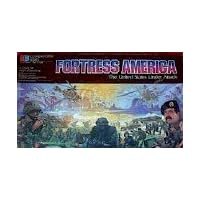
This is an extremely well-balanced game that is heart pill-poppin' extravaganza. I absolutely must recommend that you obtain a copy for yourself (preferably the controversial edition with the Saddam Hussein picture on the front) and join the fight for the control over the US. You may find yourself shouting "Wolveriiiiiiiiines!" many times during the course of the game too!
Click Here to see more reviews about: Fortress America
THIS IS A USED GAME. ALL PIECES ARE INCLUDED AND VERIFIED. BOX MAY HAVE SOME WEAR. BOX MAY HAVE TAPE ON IT THAT IF TAKEN OFF WOULD RUIN IT. PLEASE NOTE: THAT WE DO NOT SHIP OUR GAMES VIA PRIORITY MAIL OR INTERNATIONALLY. WE PROVIDE NEXT DAY SHIPPING WITH A DELIEVERY CONFIRMATION NUMBER. WE WILL EMAIL YOU ONCE YOUR ITEM HAS BEEN SHIPPED OUT.


0 comments:
Post a Comment