Showing posts with label economics. Show all posts

Power Grid: Russia and Japan Review

Power Grid: Russia and Japan
Average Reviews:

(More customer reviews)
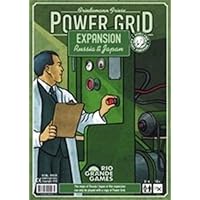
This expansion includes a board with two new country maps for the popular Power Grid board game. Each new country map comes with some slight rule modifications that affect the strategy in subtle but interesting ways.
For Japan, the rule changes include:
* Players can build two independent power networks starting in different areas of the country.
* A network can only be started in one of six starting cities, which means players are often competing for position from the start of the game. The starting cities can each be occupied by two separate players in step 1, to allow each player an opportunity to start both of their allowed networks.
* Coal, oil, and uranium start out slightly more expensive than in the base game, while garbage starts out cheaper.
For Russia, the changes include:
* The power plant market is more limited. In the first two steps of the game, three power plants are in the current and future markets (instead of four), and the market size in step 3 is four (instead of six).
* The two lowest value garbage plants are removed from the game, and no garbage is available to purchase at the beginning of the game.
* The lowest valued power plant in the market is removed when the first player chooses not to bid (instead of when all players choose not to bid).
* Oil and uranium start out much cheaper than in the base game. Coal is more expensive, and garbage is not available until after the replenishment round at the end of the first turn.
* The resource replenishment tables are different. Coal generally replenishes more slowly than in the base game, oil replenishes more quickly (in the first two steps), and garbage replenishes more quickly in step 1 only.
A nice thing about this expansion is that a small number of rule changes can have a fairly dramatic effect on game strategy. For example, the differences in resource supply on the Russia map can significantly affect the relative value of different power plants. Suddenly a small oil plant becomes more attractive than a small coal plant because coal is scarce and expensive throughout the game.
All in all, both new country expansions are easy to pick up if you're already familiar with Power Grid, and are every bit as fun as the original.

Click Here to see more reviews about: Power Grid: Russia and Japan

Two new expansion maps for Power Grid: Russia on one side and Japan on the other.In Russia the market for power plants is restricted. Additionally, the standard rules for exchanging out of date power plants are changed, forcing the leading players to completely rethink their strategies.Based on the crowded geographical surroundings, the players can start two separate networks in Japan. The first connections are restricted to certain cities, guaranteeing a tough fight for the best networks.

Buy Now

Click here for more information about Power Grid: Russia and Japan

Read More...

Steam, Rails to Riches Review

Steam, Rails to Riches
Average Reviews:

(More customer reviews)
The game involves everything that Power Grid does, and then some. Planning, chance, diplomacy, economics, there is so much that can go wrong while planning the most in/efficient rails possible that no two games are likely to play the same with more than three players. This game is a great addition to any collection of family and friends games for friendly (or ruthless) games.
It can take 45 minutes or 2 hours, it all depends on how complicated you make it and whether everyone is trying to win... or there is someone just trying to ruin someone's chances.
This game is a definite 9/10

Click Here to see more reviews about: Steam, Rails to Riches

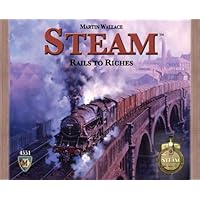
Steam places you in control of a railway company, with goods to deliver and track to be built! Opportunities abound, but your opponents can also take advantage of goods demands and the terrain to challenge you. Spend your money carefully, create a network of tracks to connect cities, and deliver goods to become the greatest railroad of them all!Designer Martin Wallace has revisited his classic design, streamlining it and creating not one, but two new versions of his masterpiece! Players new to the game can learn with rules that emphasize ease of play and a shortened play time, without losing the tension and excitement of the game. For those who are (or become) experienced with the game, a more challenging version introduces auctions and maintenance costs to challenge even the most savvy of players.This new edition's components are compatible with previous editions of Wallace's game, so that current players can use their own maps with this edition. And, this base set gives you all of the parts you need for 3 to 6 players to explore the world, starting with this set's maps of New York and Germany's Ruhr Valley. Get onboard and get ready for fun!Steam is designed by Martin Wallace, and plays 3-6 players. Game time is around 90 minutes, for players 10 years old and up.Game Contents: * Full Color, Double-Sided Map Board of Two Different Geographic Areas at the Beginning of the Railway Age o The Northeastern U.S. and Adjacent Canada Map is Best for Three to Four Players o The Lower Rhine and Ruhr Region Map is Best for Four to Five Players * Pieces for Six Players are Included * 130 Double-Sided Track Tiles (of 15 types) * 8 "New City" Tiles * 24 Wooden Player Tokens (in six colors) * 96 wooden Goods Cubes (in five colors) * 8 "New City" Tiles * 7 "Action" Tiles * 18 "City Growth" Markers * 52 Gold and Silver Money Tokens * 1 Turn Marker * 1 Cloth Goods Bag * Full Color Rules Booklet Covering Both the Basic and Standard Games

Buy NowGet 10% OFF

Click here for more information about Steam, Rails to Riches

Read More...

Container Review

Container
Average Reviews:

(More customer reviews)
Disclosure: I purchased Container a few weeks ago and since then I have been able to play 4 or 5 games. All the games I played were 4-player, so my knowledge of the 3 or 5 player experience is inferred only.
Container is a Euro-style board game. For those unfamiliar with this genre, Eurogames are generally defined as games involving no player elimination, low randomness and only indirect player conflict. You are a shipping company owner, producing, trading and stockpiling goods as you strive to turn the highest profit. The theme of the game, shipping containers to a mysterious island, is about as abstract as the game is itself. It does a good job of giving some sort of structure and metaphor to the game actions, while not being too distracting.
Physically the game is simple, but elegant. The boards are sturdy and visually clear, the containers are made of wood and shaped as one would imagine. The factories and warehouses are wooden as well. The boats are pretty notable, as they are very nice to hold and made of a very sturdy material. I'm uncertain if it's plastic or some sort of stone, though plastic is much more likely. Color, however is my only complaint. There are five colors of resource: White, Black, Orange, Tan and Brown. Unfortunately, Orange/Tan/Brown are all very close in shade and can be tough to tell apart. Colorblind players or players with impaired vision might have some trouble here.
The rules of Container are pretty straightforward. The nicely printed rulebook looks thick at first, but it's actually just reprinted in many languages. The rules are concise, well-worded and clean; there won't be any hour long arguments about a poorly worded statement, nor will there be days of pouring over the rulebook before you get a handle on how to start to play. Here's a rough overview of game play, please note that some details are omitted:
Container simulates a multi-tiered market structure, which I'm going to walk through very carefully because it's a little complicated. A player produces goods, which he assigns a price to and stores in a factory. Other players can purchase those goods from said player at his asking price. Once purchased, those goods are re-priced (with a markup, of course!) and placed in the purchasing player's harbor for resale. Each player has a boat which he can "sail" from harbor to harbor, buying goods at each harbor. When the boat is full, or when the player decides it's time, the boat heads for the central island. Upon arrival, the goods are auctioned off to the highest bidder - although the player has the option to keep the goods for himself if he pays the highest bid!
Scoring at the end of the game is simple - whomever has the most dollars wins! Cash-on-hand is counted, as are resources you own but haven't sold. The key to scoring, however, are the containers you've purchased on the center island. At the beginning of the game, each player is given a hidden scorecard that determines how much each color of container is worth to him. The endgame value of each container varies from player to player, and as this information is hidden it can be tough to predict who is looking for which resources. Additionally, the first step in scoring is to eliminate the container type of which the player has most, forcing players to adopt a strategy more complicated than "collect the most of my most valuable container". Diversification is key to victory.
The player-oriented nature of the game means player skill will shape your game experience to a large extent. While expert players are not required for fun, beginning players can bring some difficulties to the game. One player in an early game of mine had a bad habit of putting together boatloads of goods he wanted, then buying them himself. Because he was giving up the income from selling his boatloads to others, he quickly found himself deep in debt, and basically broke. Unable to buy or produce goods easily, the economy got worse and worse for the other players. Eventually we had to "bail him out" by deliberately buying goods from him. Once he had some capital he was back in the game, and the economy got itself started again.
I'm not going to sugar-coat it, your first game of Container will probably be rough. The market system is complicated and it's tough to know how your actions will manipulate it. When and what to produce, how much to spend on goods, bidding on incoming boatloads of containers - all of these choices are going to be pretty difficult the first time you run into them. This is because the general "flow" of goods and money is very player-dependent, as both price and availability of goods are determined by you and your compatriots. With a little bit of thought and experience, though, you should be able to keep your head above water. Keeping a good eye for profit, as well as remembering that dollars are victory points (i.e. when you pay someone for their goods you are also shifting the final score), will see you through your first few games.
Overall, I really like Container. It reminds me of other economy games I've played (Puerto Rico comes to mind) but with its own very unique direction. Like those other games, decisions can both be evaluated for immediate gain, or speculated upon for future profit. However, the closer player interactions in Container mean that you need to be thinking about what the other players would find beneficial as well. You can price your goods however you want, but you need someone to be willing to buy them! While the initial learning curve is a bit rough, it's not as daunting as it first appears, and if your playgroup doesn't have an aversion to numbers or business acumen, I'd recommend it.

Click Here to see more reviews about: Container

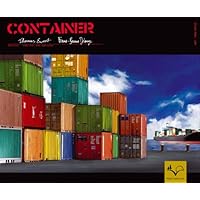
Container is a game about big ships and big production. Each player will play both the producer and shipper of goods. Players will decide which products they want to produce, and which of the OTHER players' goods they want to ship out to a remote island. During these phases, players will be able to set the prices for their goods and try to maximize their cash!Once the goods have reached the island, players will play the part of the purchaser for their tiny island. Players bid for the goods arriving each day by ship, and the highest bidder collects these goods for conversion into points at the end of the game.Sounds simple? It is! But the real challenge is turning heavy industry production into goods for your island. Your government is willing to subsidize your purchases, but just how much money do you want to give to your competitors for that lovely crate of goods your island desperately needs?Please Note:On-line retailers are not included in Valley Game's pre-order special for the detailed plastic containers.

Buy NowGet 24% OFF

Click here for more information about Container

Read More...

Power Grid Review

Power Grid
Average Reviews:

(More customer reviews)
Short Version:
This game is great. You build cities on a map of Germany or the US, connecting adjacent cities to each other along power lines. Then, you buy power plants of various sorts (coal, oil, nuclear, wind, fusion, garbage) that power a certain number of your cities for a resource cost (coal, oil, etc.). Finally, you pay resources (which you also buy) to use your power plant (or power plants, you can have up to 3) and get paid based on how many cities you have that are receiving power. You repeat this progression (though not in the order described -read below for full details).
Basically, this game is sort of a blend of Settlers of Catan and Ticket to Ride, with some added twists. It plays with 2 to 6 players, with the game adapting somewhat with more or fewer players. I'd guess it's not for kids younger than 10, but it is hard to say. The game is somewhat complex in strategy, but pretty basic in number of rules. It plays in about 2 hours. The board looks great, the pieces are of excellent quality, and there is quite a lot of room for strategy (no die rolling, so not much depends on chance). This is my favorite Rio Grande Game and pretty close to my favorite game of all (Pirate's Cove might still be the top).
Longer Version:
Each turn, you first bid with other players for different power plants. Each plant has advantages: they cost less in their initial bid, they power more cities (from 1 to 7 cities), they cost fewer resources to power cities, they use a resource that other players aren't using, or they take no resources at all to power cities (wind power and fusion power -there is only one fusion power, the most expensive plant in the game). After every player has had a chance to initiate bidding on a power plant, you move on to the next step of the turn.
Next, you buy resources that you will use to feed your power plants. There are six resources types: uranium, garbage, coal, oil. Wind-based power plants and the one fusion-based power plant cost no resources. The cost of resources varies on a sliding scale depending how many were purchased by players in prior turns. The resources also regenerate from turn to turn.
Next, you build cities using money (called Elektro). The cities cost a set amount, and you pay both for the cost to build in a city and for the cost to build power lines to that city. There are no actual power line pieces, you just look at the connecting line on the board between cities and it tells you what it costs to connect those two cities.
Finally, you fuel your power plants with resources, which generates power for your cities. Based on how many cities are receiving power, you get Elektro. After all players have built cities, the turn now ends.
That's the overview, but there are several nuances to Powergrid that add a lot of strategy. First, the more cities you build the lower in turn order you go each round. So if you have the most cities, the other players have a chance to take actions before you. They might build cities where you wanted to build them. Or they might buy resources, which causes them to be more scarce on your chance to buy them (thus you pay more for them).
Second, you don't want to build too fast or you won't be able to outbid other players when buying new and improved power plants, which can be very expensive depending on bidding.
Third, as you build more cities, the game changes somewhat, moving from "stage 1" to "stage 2" and finally to "stage 3." In each stage, resources regenerate faster (or slower), players are able to share cities (so instead of one player controlling a city, in stage 2 two players can control one, and three players can in stage 3).
This game also changes based on the number of players. With 2, you use less of the map, whereas with 6 you use the whole board. The victory conditions also change (the number of cities you have built triggers the end of the game, with various factors affecting who actually wins).
In sum, this is a great game. Very much like Ticket to Ride in general feel, but with the added resources idea of Settlers of Catan plus the bidding aspect of games like High Society or Cleopatra. It's an excellent game, and very well made.

Click Here to see more reviews about: Power Grid

Power Grid is the updated release of the Friedemann Friese crayon game Funkenschlag. The latest cooperative publishing effort from Friedemann Friese and Rio Grande Games, removes the crayon aspect from network building in the original edition while retaining the fluctuating commodities market like McMulti and an auction round intensity reminiscent of The Princes of Florence.The object of Power Grid is to supply the most cities with power when someone's network gains a predetermined size. In this new edition, players mark pre-existing routes between cities for connection, and then bid against each other to purchase the power plants that they use to power their cities.However, as plants are purchased, newer more efficient plants become available, so by merely purchasing you're potentially allowing others access to superior equipment.

Buy NowGet 30% OFF

Click here for more information about Power Grid

Read More...