Showing posts with label civilization. Show all posts

Antike Review

Antike
Average Reviews:

(More customer reviews)
Antike is a fun board game of politics and resource management. The win condition is to be the first player to accumulate 10 "achievements" (represented by cards with historical figures, with individuals correlating to the kind of achievement). There are multiple paths to winning achievements, which can make the route to the victory condition quite complex.
The board is two-sided, consisting of either the Mediterranean (centered on Rome and Carthage) or the Middle East (centered on Babylon). The map is broken up into regions or provinces, roughly congruent to historical divisions. Each region produces a good; marble, iron, or gold. Each player begins in a different civilization capital, such as Athens, Tyre, or Rome. Antike has a particularly interesting method of resouce management. There is a "production wheel" that has the 3 resources that can be produced (marble, iron, gold) and the 3 products that consume those resources (temples, soldiers, science). On your turn you can produce a resource type or consume them on a product type, but you can only move around the dial up to 3 spaces for free (moving farther on the dial costs resources). Also, there is only one production wheel, so your options depend on what your opponents do. There is also a generic payout of resources on every full round (like passing "Go").
Building temples increases the amount of resources that are harvested from a region, and helps to defend the region from invasion. Soldiers are built with iron and are used to garrison new regions (to harvest their resources) or to fight enemy civilizations. Science is bought with gold and gives bonuses like extended movement or better defense.
Achievements come from building temples, destroying other temples, and discovering science. It is possible to win the game just by discovering science. Science can be a double-edged sword; the first discoverer gets the achievement point but pays the full cost. Afterwards, any other player can also get the benefit for a reduced cost.
Overall, Antike is an interesting game of war and resource management. The production wheel has a particularly interesting effect of causing a cyclic nature to the game. There is a lag time in responding to opponents and power consequently ebbs and flows. And a reminder that you don't win by conquering regions, you win by accumulating achievements; you may find that a military only gets in the way of victory.

Click Here to see more reviews about: Antike

Ancient nations create cities and build temples, sailed the seas, do battle and make scientific headway. Their legions and galleys defend their homeland and conquer new territories. Two-sided game board features different theaters of operation. Players choose their nation from among the Greeks, Romans, Germanic Tribes, Phoenicians, Carthaginians, Persians, Arabs, Egyptians and Babylonians. Each nation tries to win ancient kings, scholars, generals, navigators, and citizens. The first to gain a given number of ancient personages wins the game. This game contains a big two-sided game board, each side providing different strategic challenges. Winning depends not on the luck of dice or cards, but on strategic planning and smart diplomacy.

Buy Now

Click here for more information about Antike

Read More...

Avalanche Press Soldier Kings NEW Board Game Review

Avalanche Press Soldier Kings NEW Board Game
Average Reviews:

(More customer reviews)
Gave this game to my son, a big fan of strategy games and war games, for his 13th birthday. This game is comparable to Avalon Hill's Diplomacy in its level of challenge, attention to detail, and richness of experience. If your experience with strategy board games is limited to Risk, this game is a big step up in terms of complexity and the amount of time required to set up. However, the quality of the play experience is excellent, and the turns and phases move along quickly and smoothly; it's not as complex or as slow moving as something like Panzer Grenadier, also from Avalanche Press. The main scenario is based on the Seven Years' War, and has a total of 28 turns (7 years x 4 seasons). Movements and actions fit neatly into single turns, so it's easy to pause the game at the end of a turn, if necessary, and resume it at a later time.
Unlike Diplomacy, this game does incorporate dice for attack and defense, but the game's authors put a lot of thought into weighting the results according to the particular officers and the numbers of fighting units involved. In addition, the game incorporates some great innovations such as an "intimidation factor" when making an alliance, in which your likelihood of cementing an alliance is increased by the number of fighting units that you have in proximity to the state to which you "offer" an alliance.
My only complaint is that the game "boards" are sheets of paper; heavy, glossy paper, but paper nonetheless. This is very disappointing in an otherwise high quality game. Keep the beverages and the snacks on a separate table!

Click Here to see more reviews about: Avalanche Press Soldier Kings NEW Board Game


Soldier Kings is an award winning game that covers the first truely global war in history.Actually two wars in one, the Austrians and Prussians fight for predominance in central Europe while France and England struggle for global dominance.

Players control the resources of Austria, Britain, France, the Netherlands, the Ottoman-Turkish Empire, Prussia, Russia or Spain.Counters represent armies, navies and leaders.Units maneuver on two large, point to point maps.Cards bring an element of randomness that keeps any player from feeling too snug with his or her position.


Buy Now

Click here for more information about Avalanche Press Soldier Kings NEW Board Game

Read More...

Settlers of Catan Cities & Knights Expansion Review

Settlers of Catan Cities and Knights Expansion
Average Reviews:

(More customer reviews)
I got this expansion along with the original game and played it after playing a couple games with the original rules. The basic changes to the original game include:
1) Instead of the development deck, you now have three progress decks (sciences, trade, and politics) which offer a broader selection of usable cards than the development deck and it's 90% knights and 10% events/actions. These decks correspond to three possible areas of improvement (see next item) and have some interesting effects (everything from allowing you to take cards from another player to pulling resources for free).
2) Cities can now be improved. You get a set of flip cards that you flip as you purchase city improvements. There are two benefits to city improvements: a) when you achieve the 3rd level of improvements you gain some bonus like the ability to trade 2:1 on any resource, and b) each improvement increases the changes you'll get to pull from one of the three progress decks.
3) The addition of an event die that you roll along with the standard 2d6. The event die will either move the barbarians closer (50% chance) or trigger a chance to pull from the progress decks (16% chance). As mentioned, city improvements increase your chances of scoring a card when one of the progress areas are rolled (i.e. if you get a 1 or 2 on the red die and a blue icon on the event die and you have the first city improvement in the science area, you can draw a card).
4) barbarians have been added on top of the robber that still plays as it does in the original game; the barbarians show up after the barbarian icon shows up on the event die (which is more often than not). When the barbarians reach Catan and if there aren't enough knights in play to protect Catan, then the weakest player (in terms of knights) who has a city will lose that city (it gets downgraded to a settlement) as it gets razed by the barbarians.
5) knights are now pieces in play rather than a drawn card; they can bump other knights and the roober and play a crucial role in dealing with barbarians: if the number of knights who are active exceeds the number of barbarians (= number of cities in Catan), then the players win and the player that contributed the most will receive a special Defender of Catan card (ties result in progress card draws) which gives you a victory point.
6) Lastly, to make things interesting, there are commodities now, coin, paper, and cloth (which correspond to iron, wood, and wool resources) which are primarily used to buy city improvements. You get them if you have cities (i.e. instead of getting 2 iron if you have a city next to an iron spot, you get 1 iron and 1 coin).
Yes, it's definitely more complicated than the original rules but it offers a choice for anyone who wants that complexity (me!). It makes the game deeper and in some respects fixes issues I had with the previous game (like the knights being way too easy to pull up off the development deck given their numbers).
Once you get used to the rules (one or two games will usually do it), things move along and tides can turn pretty quickly (like when you were unable to active your knights before the barbarians came and you end up losing a city...or when Catan still wins but you just handed your opponent a Defender of Catan card which secured another victory point).
All in all, if you liked the original game and are either bored with the simpler rules or want to mix up the game a bit more, then I highly recommend this expansion. The added rules and expanded progress cards and city improvements really evolve the game in a good way and bring out the best of this game.
Oh, and note that you need to use this with the 4th edition (Amazon made sure to label these with that big "New 4th Edition!!!!" tag...). I never had the original versions so it didn't matter to me but some reviewers seemed to have an issue with getting the wrong edition so...


Click Here to see more reviews about: Settlers of Catan Cities & Knights Expansion

Wild barbarians, lured by Catan's wealth and power, maneuver to attack. Their massive warships loom against the orange horizon. You must be strong! Barbarians attack the weakest targets, and the victim of their onslaught will be the player who contributes the least to the defense of Catan. Don't take any chances! Field your knights!
In The Cities & Knights of Catan, you engage in the defense of Catan and compete to build the three great metropolises of Catan. Each of these magnificent centers are even more valuable than cities and are safe from the barbarians. You must invest in city improvements, which you acquire using commodities of trade: Coin, Paper, and Cloth. If you improve your culture, muster your knights, and enrich your cities, you will be the master of the great realm of Catan. This edition features all new artwork, and an insert tray to hold game components for up to 6 players.

Buy NowGet 33% OFF

Click here for more information about Settlers of Catan Cities & Knights Expansion

Read More...

Through the Ages-3rd Printing By Eagle Games Review

Through the Ages-3rd Printing By Eagle Games
Average Reviews:

(More customer reviews)
Since receiving this game it has dominated my gaming table and quickly become my favorite boardgame. This is a meaty, civilization based game for 2-4 players that can be played in anywhere from 2 to 4 hours (essentially 1 hour per player once players are experienced). It can be a bit daunting getting started but if you stick with it for a couple of plays, you will be rewarded with a very rich and satisfying civ experience. You start out with a despot government, no leader, one warrior, two mines, two farms, a science lab, and one worker in your worker pool. You also begin with 4 civil actions and 2 military actions(these can be increased by cards obtained during play). From here you must build your civilization to try and surpass those of your opponents. Each turn you must pay attention to many different items. You need to balance and manage your science production, your farm output and feeding your workers, your mining output and corruption, the happiness level of your population and uprisings, your military strength, and lastly your culture points, as the player with the most culture at the end of the game is the winner. The game plays through 5 ages: Antiquity (lasts one turn), Age I, Age II, Age III, and Age IV (also lasts only one turn). You can win with almost any combination of cards(leaders, wonders, governments, territories,urban buildings, technologies,etc...) provided that you are not the weakest militarily. Just as in real life, if you are by far the weakest, your civ will be robbed and pounded into the dirt for your frailty. The game is very well balanced and requires you to maintain that same balance within your own civilization. If you are a fan of meaty, low luck boardgames, this game is for you and you should buy it immediately. The only luck in the game is based on turn order and card order, which can easily be mitigated. For any questions that you may have regarding play, there is a vast, expert, compendium of knowledge on a website called boardgamegeek that will help answer any lingering questions that you may have on nearly any aspect of the game.
For those of you wondering about how this compares to The 2010 Sid Meier's release of Civilization the boardgame, they are related but have vastly different game play. While I do enjoy the new Civ, it still does not compare to the experience that you will get with Through the Ages.
Happy Gaming :)

Click Here to see more reviews about: Through the Ages-3rd Printing By Eagle Games

Through the Ages is an exciting game of strategy and resource management. Players guide their civilizations up from Antiquity, through the Middle Ages, and into Modern Times. What will your civilization be like? Will it be warlike?Technologically advanced? Religious? Artistic? Choose from Leaders such as Hammurabi, Napoleon, and Ghandi. Build the Pyramids, the Great Wall, or the Eiffel Tower. Your Civilization's culture is yours to shape and you can do it differently every time you play the game. Through the Ages is playable in three different difficulty levels. Play the short Tutorial Game to learn the game mechanics. Play the Advanced Game when you are ready to face the consequences of politics and corruption. And when you want an even greater challenge, play the Full Version of Through the Ages and take your civilization from spear-throwing to space flight.

Buy NowGet 33% OFF

Click here for more information about Through the Ages-3rd Printing By Eagle Games

Read More...

Civilization: The Board Game Review

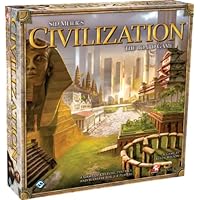
Civilization: The Board Game
Average Reviews:

(More customer reviews)
After 4 games, I would like to share my impressions and rules details.
We are are 2 player household and I think it will be very seldom we play this game with more players.
I think the most important I have to mention is, that both players simultaneously said that this game is more Civ than any other Civ boardgame before. It definitely feels more Civ-like and it plays more Civ-like. It is very difficult to assure my friend playing games with 3 or more hours, but this time it is easier than ever.
For us there is only one minor contra I have to mention: there are a lot technologies, but while playing you can figure out what you need next. If you follow a special strategy you will pick up the techs you need quickly and set back those you don't need. We do not feel upset by small figures or cards. Just the loading space for every game component is laughable. It is not possible to save any components well until you buy pleno boxes. You will need them definitely.
The Pro's: the game mechanics are amazing. The culture with its cultural action cards is my favorite. At one moment I was surrounded by 2 armies and I choose to go 2 steps forward at the cultural line, getting 2 cultural action cards, both the same (what a luck) and both allowed to be used in the next movement phase. It was "defection", meaning that I can kill a figure (so the army flag on the board is a figure) within 4 squares of my position. Since I was surrounded by 2 armies, I could kill both figures (not the armies) and my opponent was really not amused.
So my conclusion: my top game for a while I think. We love it, you should get it as soon as possible.The Rules
I am always the one who reads the rules and than has to explain them. So I did here, too. The rules are clear written, easy to understand (even for me as a non-native speaker) and easy to explain. The only part I had to read more than once was combat, because it's better to play an example than to read it. In one case I could not find the meaning of a "2" on the barrack building, but after a short search I found it. 14 pages of the rules are explanations of tiles and how to setup start. Once you have done it, you know it. Perfect!!
The Civilizations and the Map
We played - the luck of the draw - as Bismarck und Catherine of Russia. While playing I saw that there is no single strategy for a civilization, even if the capital is always on the same tile (if you wish to do so in future games). It definitely depends on the map you discover. Discovering a new map means you flip over the map. Every map has a white arrow on it. The map is arranged in the way that the arrow shows away from the figure which entered the new map part (If the figure comes from South, the arrow shows to North.). It's funny to see that the opponent is surrounded by water without having invented navigation or sailing yet.
Every civilization has a starting government (most are Despotism with no affect at the beginning) and 2 special abilities. Russia's starting government is communism, gaining one culture at the start of every turn, so I decided to go the way of the culture first (later I switched to tech, unfortunately). Russias special ability is 2 more hammer in its capital and a second army figure right from the beginning of the game.
Bismarck for example has 2 infantries extra at start which is horrible for an early fight against him. All other Civs will be played next.
Here is the summary of all Civs:
The Egyptians: start with a free ancient wonder drawn at random in their capital. Once per turn, during City Management, the Egyptians may build an unlocked building for free by using an action. Starting Gov: Despotism, Starting Tech: Construction (level 2 Tech).
The Romans: the Romans advance one space on the culture track for free each time they build a wonder or a city, and each time they conquer a city or village. Starting Gov: Republic (Your armies may build cities as though they were scouts. Your scouts may explore huts, but not villages.), Starting Tech: Code of Law (level 1 Tech)
The Americans: The Americans start with a free random great person in their capital. Each time the Americans convert 3 trade into production, they receive 2 production (hammer) instead of 1. Starting Gov: Despotism, Starting Tech: Currency(level 1 Tech).
The Chinese: The Chinese start with city walls in their capital. The Chinese gain 3 culture each time they explore a hut or conquer a village. The Chinese may save one of their killed units after each battle, returning it to their standing forces. Starting Gov: Despotism, Starting Tech: Writing (level 1 Tech).
The Germans: The Germans start with 2 extra infantry units. After setup, each time the Germans research a tech that upgrades or unlocks a unit, they build one of that unit for free and gain one resource of their choice from the market. Starting Gov: Despotism, Starting Tech: Metal Working (level 1 Tech).
The Russians: the Russians start with 2 armies, and their stacking limit is increased by 1. Once per turn, the Russians may move an army or scout into an enemy city and sacrifice that figure to research a tech known by that civilization for free. Armies sacrificed this way cannot also attack. Starting Gov: Communism (Each of your cities generates 2 extra hammer/production. Your capital produces 1 less culture when devoted to the arts.), Starting Tech: Communism (level 3 Tech).
Gameplay
There are 5 turns in every round.
I. Start Turn
BUILDING NEW CITIES
If you have fewer built cities than your maximum number of cities (at start: 2, with Irrigation 3, more cities do not exist) you can build one or more new cities on the map. Use your scout figure in a square, press B remove the scout and found a new city by placing a city marker unwalled side up. There are several requirements for settling (I don't want to got into details). The city center never generates anything as long as there is a city on that square. Never! Only the outskirt squares provide icons and resources.
CHANGING GOVERNMENT
Governments get unlocked through tech cards. At the start of the game players have only unlocked the Despotism government (exception: Rome and Russia).
Once a player unlocks a new form of government during Research Phase (learning a new tech), they may change to that government during the Start of Turn Phase of the following turn. In that case place the goverment card at your civilization sheet.
A player can only change directly to the new found government next turn without Anarchy. If you want to change to another (also available) government, you will have Anarchy. After being in Anarchy for a complete turn cyclus, you can change to any other government during the Start of Turn Phase of the next turn.
GOVERNMENTS
Anarchy: Your capital loses its action this turn. Next turn you may change to a different government you've unlocked.
Fundamentalism: Your battle hand size is increased by +1. You collect 2 less trade than normal each turn.
Communism: Each of your cities generates 2 extra production/hammer. Your capital produces 1 less culture when devoted to arts.
Democracy: You collect 2 extra trade each turn. Your armies cannot attack cities.
Republic: Your armies may build as though they were scouts. Your scouts may explore huts (but not villages).
Despotism: no effects
Monarchy: Your capital generates 1 extra culture when devoted to arts. Your culture hand size is increased by 1.
Feudalism: Each of your cities may harvest resources found in your other cities. Put one coin token on the card as income as long as you are in Feudalism.II. Trade
COLLECTING TRADE
Count all your trade symbols in all your cities and increase your trade dial on the civilization (maximum is 27 trade). Unlike production, trade is saved from turn to turn if you don't spent it.
SCOUTS AND BLOCKADES
If a scout is somewhere outside your city outskirts and there is a trade symbol on it, the scout also gathers that trade. Scouts have other gathering functions, which are mentioned later.
If there is an enemy figure in your city's outskirt, your city does not produce trade on that square.
NEGOTIATIONS BETWEEN PLAYERS
After trade is collected, players may negotiate among themselves. Objects of negotiating are:
- non-binding promises
- points of trade
- unspent culture tokens
- resource tokens (from the market or from hut/village tokens)
- culture event cards (attention to the culture hand size!)
Other objects may not be traded.III. City Management
You can do one of the following 3 turns this phase in each of your cities.
(A) PRODUCING A FIGURE, UNIT, BUILDING OR WONDER
Count the total production of one city which is displayed as hammers in a cities outskirt. You cannot combine the hammers of 2 or more cities, but you can change 3 trade into 1 hammer (as often as you want) on your civilization sheet.
You have to decide between producing a figure OR a unit OR a building OR a wonder.
After producing a FIGURE(army flag or scout) the figure is set in the cities outskirt, not on the city or water tile (until you can enter water tiles). There can be only as much figures in a quare as your stacking limit allows to you (2 at the beginning).
UNITS represent your standing force, which is always only one pool of cards regardless how many flag figures you have on the map. At the beginning of the game there is a small colored unit marker for every player under the...Read more›

Click Here to see more reviews about: Civilization: The Board Game

Bring the experience of the best-selling computer game series to your tabletop!2-4 Players explore the world, research new technologies and build an empire.Will you conquer your enemies on the battlefield or use diplomacy to win over your neighbors?Begin with a single city, and spread your influence across the world.Four distinct paths to victory and a modular game board ensure that each game is a new experience.

Buy NowGet 38% OFF

Click here for more information about Civilization: The Board Game

Read More...