Average Reviews:

(More customer reviews)First off, be sure that you love REALLY long games with complicated rules and LOTS of pieces on the board (and that you have friends who like the same thing) before purchasing. That said, this is an awesome game.
I never played the un-revised version, so I have no way of comparing the two. I did, however, love everything about this version.
The game board is thick cardboard folded in 6 parts. It is of high quality, and it's longer than the standard game board. It is a map of the world and most of the territories have financial values. As you attack your enemies and take over their territories, you also increase your income depending on the financial value associated with the territory that is now yours. There is an additional cardboard piece that allows you to track the changing income. (Lots of table space required for all of the additional stuff).
You also can do something called weapons development. During your turn you have the opportunity to buy dice to roll to give yourself advantages. Some examples of advantages are increasing the defense strength of your jet fighters, allowing your anti aircraft guns to shoot at industrial complexes, and increasing how many spaces your aircraft can fly, etc. If you roll the number needed to create the development, you may now use this added ability for the rest of the game. This is risky, because money is limited, and you are not guaranteed to roll the appropriate #.
There are plenty of plastic pieces that come with the game.The pieces that come with the game are: aircraft carriers, battleships, destroyers, submarines, transports, infantry, artillery, tanks, fighters, bombers, anti aircraft guns, and industrial complexes. In order not to lose all of the parts, I got small tackle boxes for cheap at Walmart and used a label maker to label everything. It's a lot less messy than keeping all of the little parts out on the table in front of you. There is a card which tells you how many of these pieces to put on the board to start the game. The set up time takes a little while because there are a lot of pieces to put down to start the game. The card is full of valuable information. It tells you how much it costs to buy each unit, how many spaces they can move across the board, how strong they are on attack and on defense, turn sequence and combat sequence...basically everything you need to know to play the game. Each power (Soviet Union, Germany, United Kingdom, Japan, and the United States) starts with varying amounts of money and troops. Germany and Japan starts with lots more troops but less money, so they have more incentive to attack quickly to increase their income. The allies are a little more challenging to play due to the fact that, inspite of the fact they have more money to start the game, the united states and united kingdoms resources are located across the water, and it takes a bit to transport these troops and get established in areas they need to be in. The soviet union can quickly get overwhelmed by germany since they have little money and not that many troops, plus a lot of land to defend.
When I first learned the rules to this game I was completely confused on many points. It took a full day of trying to figure them out. Then I emailed the manufacturer and kept asking questions until I felt comfortable. There are a few websites out there that give some good answers to questions as well. Once you learn the rules, however, it is easy. I just think whoever wrote the manual could have made it a whole lot easier to understand than it is.
Gameplay is pretty basic. You do the following in this order: You develop weapons if desired. You purchase units, conduct combat if desired (troops from multiple territories can attack one territory), do any non-combat moves, mobilize the new units purchased at the beginning of your turn to any territories that have Industrial Complexes on them (you can buy more industrial complexes to place on different parts of the map) and then collect your income. You may discuss strategy with your allies, and as a matter of fact that seems to be a major part of what takes up so much time. I got frustrated by the fact that the enemy could hear what was being talked about and pointed to on the map, so I developed a means of silent communication via dry erase boards. I took a photo of the game board that I found on the web, and in photoshop I enlarged it to the size I wanted and faded out the image to pastel colors so that it would be easy to write over the top of it. I then went to a home improvement store and cut out pieces of thin wooden board to mount the pictures on and covered them with thin clear plastic sheeting I got from an art store. I taped them down at the edges with duct tape and bought some dry erase markers and erasers. This way both the axis and the allies had their own dry erase boards where they could point out areas of concern on the map without being seen by their opponents. I also developed an easy shorthand type of code to quickly communicate to each other via the boards. This made a fantastic addition to the game and made communication easy and private.
Here are a few notes on gameplay which may help your understanding of the game:
-Allies may occupy the same territory. If they are attacked, they defend together at the same time. If they attack, they must attack seperately on each power's seperate turn.
-Sea units can only attack sea and air units (unless it's an amphibious assault, then a battleship may do an initial attack on land as the units are going on shore), land units can attack land and air units, and air units can attack both (the submarine can't shoot at air units, but after the initial first attack can submerge and escape if they weren't destroyed from that first assault).
-During combat you use a "battle board" where the pieces in combat are placed on the board on the attack side and the defense side. Each side shows where the units should be placed according to their defense and attack value. For instance, if you have 3 infantry, two tanks, and one fighter plane attacking a territory, each of those units have different attack values and are placed in different columns of the battle board. The infantry attack value is "1", which means that you have to roll a 1 to have a "hit" on the enemy. You would roll 3 dice for the 3 infantry and hope to get as many 1s as possible. If your attack is successful and for example you roll two 1s, your opponent decides which 2 troops of theirs gets hit in the attack and moves them to the "casualty zone" at the bottom of the battle board. The reason they are not moved off of the board is because technically you are shooting at each other at the same time, and those troops that got hit still will have their opportunity to respond and shoot back. Then the next column is resolved. The tanks attack value is a "3". So you would have to roll 2 dice for the two tanks and hope to roll a 1,2, or 3 to have a "hit" on your opponent. The fighter has the same attack value as the tank. So you could roll one extra dice at the same time as the tanks since they have the same attack value at 3 or less. Then the defenders resolve their troops. The defenders have 2 infantry. The defense value of infantry is "2". Infantry has a stronger defense than attack value (maybe because they are fortified?) So, the infantry needs to roll a 1 or 2 to get a "hit". After all casualties are put in the casualty zones, these zones are cleared, and if there are any troops remaining on the battle board, the attacker gets to decide whether they want to continue attacking or retreat. Each round is resolved this way until the attacker wants to stop or the territory is captured.
-Aircraft carriers can carry up to two fighters, and transports can carry two units.These units can't defend themselves during transport, and the transport only has a defense value of 1, so it is wise to escort the transports with other sea units.
-The game can be shorter by deciding on how many victory cities you want to capture. Or you can play the full game to total conquest, but that takes all day. I've had games where I started at noon and ended at 1 or 2 in the morning and the game was still not finished (almost).
-There are additional "national advantages" that are optional. They are a list of advantages each power can use once during the game. Here are a couple of the Soviet Union National advantages to give you an idea of what these are like:
Russian Winter- Once during the game in your collect income phase, you can declare a severe winter. Until the start of your next turn, your infantry defend on a 3.
Trans Siberian Railway - In the non-combat move, your infantry, anti aircraft guns, and artillery may move two territories per turn only among these territories: Russia, Novosibirsk, Yakut SSR, and Buryatia SSR.
These are two examples of the 6 National Advantages for the Soviet Union. Each power has 6 national advantages they can use. This is for the advanced player who wants to add some more interest to the game.
To sum up - This is a complex strategy game. It's not easy to win. There are a ton of differet ways to approach winning the same game, so the replayability is high. Definitely one of my favorite games, and it's a classic.
Click Here to see more reviews about: Axis And Allies Revised
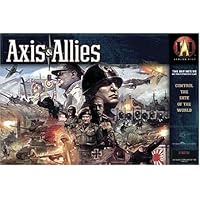
Control the fate of the world in this incredible game of military strategy, courage and cunning. Play this updated version by Larry Harris, the game's original creator. With all-new packaging art, a redesigned map and new artillery and destroyer pieces, this classic game is prepared to take on a whole new generation. Players can change the course of history in a few short hours as they maneuver over 350 playing pieces including armies, ships, planes and more. For 2 to 5 players.

Click here for more information about Axis And Allies Revised

0 comments:
Post a Comment