Average Reviews:

(More customer reviews)
I really liked the production quality of the game. The game board itself is nice, with all the references you need, just like Caylus. You'll see the special power cards, and iconic representations of what they do. These same legends are on the cards themselves.
Now one of the things like I liked production wise was the fact that they weren't your standard playing cards. They weren't even the larger tarot sized cards. They cards themselves were of the same dense cardboard as the game board. I imagine this is because, in fact, they function as a modular game board during play.
There are 4 rounds, and each round the first player takes 8 of these cards after shuffling them up and places them in sets of two (these sets are called "Areas"). So each round you have 4 of these areas (composed of 2 cards each) face down, in a square. On the back of each card is a symbol, which indicates what's on the front of the card. On the "face" (or front) of the card there is the face of one of the "patrons", who give you special abilities when you tap in further rounds after you pick the card up. Aside from the symbol, on the back of the card there may also be a number, which indicates the number of VP you'll score if you take that card.
So how do you get to take these cards from the modular board you've created? By claiming the area. Since each area is one of these 4 sets of 2 cards, you are able to claim it if you have the most workers on the area. It's not quite as simple as that, since you really only get first dibs on which card you want. Any other players in the area get to take cards as well, but they get your leavings. Unless, of course, you decide not to take a card at all.
You see, you can claim a spot in the museum instead of picking up one of the cards. The museum is importance, since at the end of the game, any cards you've claimed will be scored depending on your position in the museum. Each patron has a wing in the museum, and if you have claimed a spot there, your cards with that patron on it will be worth that number of points. In each "wing" of the museum there is a 3 spot and a 5 spot. But in between the wings there are also 2 spots. You can only claim a 5 spot if you've got a 2 spot or 3 spot adjacent to it. The 3 spot gives you a good score in that wing, but only that wing. The 2 spots are adjacent to two of the wings, since they're in between both of them and join the two. By placing your guy there, you've got a good chance to jump in on the 5 spots and claim the choice spots for that patron. Only it's only really beneficial for you to have that spot if you've been picking up the cards on the modular board that are of that patron's type.
So how do you actually get guys on these areas to claim them? Each card is split up into 6 orthogonally adjacent regions. In each turn, you're able to take a worker from your supply of workers (11 new workers come each round in a 3 player game) and place him in one of these regions. Alternately, if you've already placed a worker, you can place two of your workers near that region, thereby extending your region. The caveat to that is that your second worker must be adjacent to the first placed, not the original worker. So you place worker A to start, and then next turn you place worker B orthogonally adjacent to it, and then in the same turn place worker C orthogonally adjacent to worker B. You're able to stake a claim, as it were, on certain regions.
There's a tactical component to these placements as well, since there are also pyramids on some of the regions that you can't place a worker on. So you can effectively block your opponents progress by not allowing them to extend their existing placements effectively. Judicious worker placements are key to effectively claiming regions.
In addition to placing a worker or extending a worker's placement, you can decide to pass. You'll add your marker to the passing track, and if there's a tie in worker count in one of the areas (sets of 2 cards) you'll win the tie if you've passed sooner (if your marker is sooner on the passing track).
So you play out your guys, and eventually pass when you run out of guys to play. You then claim the areas, and take your card or place a guy in the museum. Then a new round starts, with the person last on the passing track starting the round, placing the areas, and putting one of their workers down.
Simple enough, right? Well, there are a couple more twists. As I mentioned, as you claim cards from these areas, you're able to tap them. This means that you can use the special power on this card once a round (and there are 4 rounds). These powers include the ability to place two guys initially instead of one, to extend with 3, to place on pyramids (I call this guy "The Mole"), to take a guy from the general supply (instead of your 11) and place him, and to place a guy directly in the museum instead of on the modular board.
Also, in the last round, instead of placing 4 regions, you place 6 (for a total of 12 cards). By this time, the museum was mostly taken in our game, and so people were strategically taking those cards that would benefit from their museum placements. Since there are more than normal regions, this means that your presence in each area is thinned. And since dudes are taking cards,, this means that the third place guy isn't going to come out with a card. So you've got to be a little more concentrated in this round (or so it seems to me after reflecting on my first game).
So how did it play out? I really enjoyed the modular board mechanic. This will add a lot of variability to the game, but it still retains it's "perfect information" aspect. I like the tactical placement of the workers on the board (to prevent extensions), and strategically taking cards that will benefit you in the long run.
John got a couple of Ms. Violet, who allows you to place guys out of the general stock instead of you allocated +11 workers. This, I feel, is what won the game for him. By having those workers on the board he was that much more productive than me. While I may have made better tactical worker placements, and had 2 of the 5 spots, and all but one of my cards scoring in those 5 spots, he had more cards, and there were tangible benefits of tapping those cards during the game. I had 56 at the end, John had maybe 5 or 6 more than me, and Melissa ended up with a little over 40. She got squeezed out of the 5 spots in the museum.
I had both the "extend by 3" and "initially place 2" cards in stacks. While this allowed me to push my will on the board, I soon ran out of steam and ended up passing. One of those powers is good to use, but not both. I'd much rather have had something else, in retrospect.
I also noticed a scoring rule where if you have all 5 patrons, you'll score 5 points for each permutation of that. I think that this will allow a player who has gotten squeezed out of the 5 spot to diversity and still score big.
All in all I really enjoyed the game and am looking forward to playing again. The depth and quickness of play and the variability of the game board really do it for me.
Click Here to see more reviews about: Mykerinos
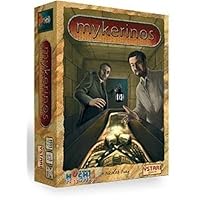
1899. For more than a century, the European public has been fascinated by Egyptology and the discoveries of Denon, Champollion, Petrie and others.Seeking adventure and glory, teams of archaeologists search the sands of Egypt for hidden treasures.The players embody archaeologists working for patrons. They excavate the land of Egypt to find precious artifacts, which will adorn the most prestigious rooms of the Museum. Players: 2-4 Ages: 10 and up Playing Time: 30-60 minutes
 Get 9% OFF

0 comments:
Post a Comment