Average Reviews:

(More customer reviews)Chess is one of those very rare games that takes minutes to learn, but a lifetime to master. It's never played the same way twice, even among grandmasters and close friends. It requires (and encourages!!) the ability to think ahead and plan carefully, and is enjoyed by people as young as 5 and as old as 125. It's a complicated game where you have to mange and plan the moves of your own 16 pieces while keeping a sharp lookout on your opponent's 16 pieces.
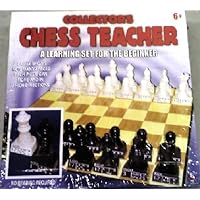
Learning the moves is usually the first difficult step that beginners take. All the different pieces move in different ways and have different rules to their movement, so this set has pieces with large bases with the most pertinent information stamped on it. The piece's name, how many spaces it can move at one time and the directions of movement are stamped on the base. As another reviewer noted, the numbers do NOT correspond to a piece's inherent point value in the game, so a player will have to think before setting up for a capture: is it worth risking a rook for a knight?? Maybe not.
Strategies like this are also missing from the instruction booklet that is amazingly thin and poorly written for what is supposed to be an educator chess set. I would recommend getting another book on introductory chess altogether if there are two beginners coming to the board. I've found this board to be the MOST helpful when an experienced player is teaching a beginner the rules and movements of the pieces. That way, the experienced player can point out difficulties or poor moves ("uh, you don't want to move there because you'll open yourself up to check"), while the beginner can get a better feel for the pieces and their movements.
A strategy that is rarely (if ever!) suggested outside of children's chess clubs and that is also missing here in the instruction book is to begin slowly. When I teach chess, especially with children, I begin with only a few pieces on the board, like rooks and bishops and the king, so the learner can get an idea how the pieces move and to better understand the GOAL of the game, which is checkmate (checkmate confuses a lot of children who think the goal of the game is to CAPTURE the king, not make it impossible for the king to make a legal move). As the learner gets better, I substitute or add additional pieces to the game until eventually we have the standard board setup. It's at this stage, especially, that an educator set is helpful--LOTS of stuff is on that board and it's pretty cluttered by midgame. By knowing how your OWN pieces move (and how far they can move), you can understand how your opponent's pieces move.
I had a set like this when I was a child and the pieces were much more stylized back then-the knight didn't look so much like a horse as a weird, squished mask-like thing. I'm pleased to see that the manufacturer has revamped the design of the pieces themselves, and would encourage them to revamp their instructions as well.
Click Here to see more reviews about: Chess Teacher
This Chess Teacher is a learning set for the beginner. Have you always wanted to learn how to play chess' The Chess Teacher easily shows how many spaces each piece can move and in which directions. No reading required. Complete with deluxe 15" x 15" chess board. For two players.


0 comments:
Post a Comment